
2. Evaluate the Optical Transceiver Design
After confirming the basic specifications, the next step is to evaluate the internal design of the optical transceiver.
Key areas include:
- Core chipset architecture
- Power consumption
- Thermal design
Core Chipset Solution
The performance of a high-speed optical transceiver depends heavily on its optical and electrical components.
Key components include:
Digital Signal Processor (DSP)
The DSP plays an important role in high-speed signal processing and overall module performance.
Major suppliers include:
- Broadcom
- Marvell
- Credo
- MaxLinear
- Other specialized semiconductor suppliers
Laser Diodes and Photodetectors
The performance and reliability of laser diodes (LDs) and photodetectors (PDs) directly affect optical transmission quality.
Common industry suppliers include:
- Broadcom
- Lumentum
- II-VI
- Yuanjie
- Sanan
- Other optical component manufacturers
Electrical Components
High-speed optical transceivers also rely on electrical components such as:
- Drivers
- Transimpedance Amplifiers (TIAs)
- Other high-speed signal processing components
The component solution should be evaluated as part of the overall optical transceiver design rather than focusing on a single component.
Power Consumption
Power consumption is becoming an increasingly important consideration as transmission speeds continue to increase.
Typical short-reach power consumption ranges include:
| Transmission Rate | Typical Power Consumption |
| 200G | Approximately 4–7.5 W |
| 400G | Approximately 8–10 W |
| 800G | Approximately 13–18 W |
| 1.6T | Expected to exceed 23 W |
Power requirements should always be matched with the capabilities of the host equipment.
Some network interface cards impose strict power limits. For example, certain 200G network adapters may require optical transceivers to operate below a specific power threshold. A transceiver that exceeds the supported power limit may not operate correctly.
For this reason, buyers should confirm the power specifications of both the optical transceiver and the host equipment before deployment.
Thermal Design
Thermal management directly affects both the reliability and long-term performance of high-speed optical transceivers.
As transmission speeds increase, power density also increases. Without effective thermal management, excessive operating temperatures may affect:
- Signal stability
- Hardware reliability
- Long-term operational performance
- Product service life
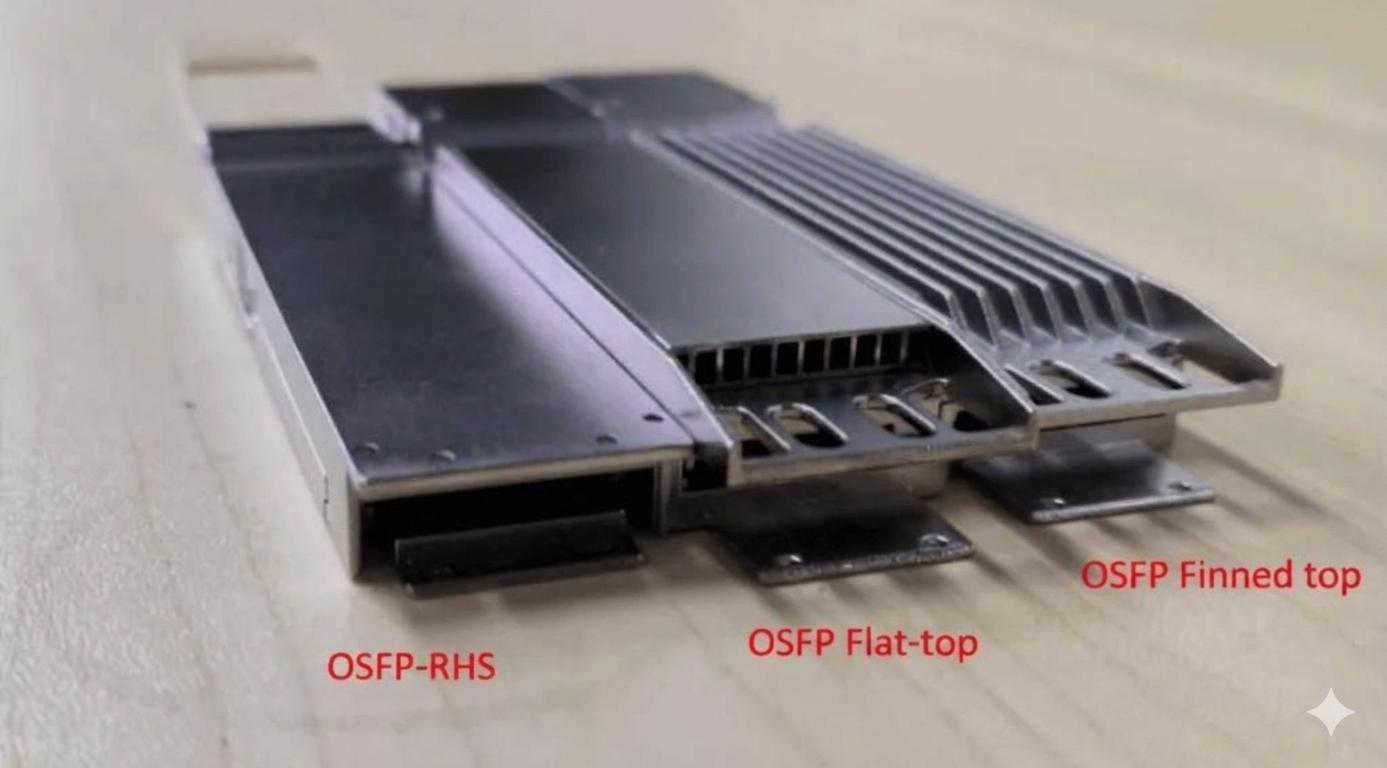
For example, OSFP transceivers may use different mechanical and thermal designs, including:
- OSFP Finned Top
- OSFP Flat Top
- OSFP-RHS
The right thermal design should balance heat dissipation performance with equipment compatibility and deployment requirements.
3. Verify Reliability Before Large-Scale Deployment
High-speed optical transceivers should undergo multi-level reliability verification before large-scale deployment.
A comprehensive evaluation process generally includes both manufacturer testing and customer-side validation.
Manufacturer-Level Testing
Typical manufacturer testing may include:
- Design Validation Testing (DVT)
- Production Validation Testing (PVT)
- Reliability testing
- Equipment compatibility testing
- Manufacturing process evaluation
- Production capability assessment
- Shipment and return rate analysis
These tests help evaluate the long-term quality and consistency of the optical transceiver.
Customer-Specific Validation
For large-scale network deployments, additional testing may be required at different levels, including:
- Chip-level evaluation
- Module-level testing
- System-level testing
System-level testing is particularly important for AI and HPC networks, where the performance of the optical interconnect can directly affect the overall efficiency of the computing infrastructure.
A comprehensive validation process should evaluate the optical transceiver under actual deployment conditions whenever possible.
4. Match the Optical Transceiver to the Application Scenario
Different applications have different performance requirements.
A transceiver that performs well in one environment may not necessarily be the best choice for another.
AI Model Training
For AI training environments, NCCL testing can be used to evaluate network performance.
Testing may cover one or two PODs and focus on factors such as:
- Effective bandwidth
- Latency stability
- Performance under different convergence ratios
Stable latency and consistent bandwidth performance are particularly important in large-scale distributed AI training environments.
Frequent Insertion and Removal
In environments where optical transceivers are frequently installed, removed, or replaced, connector durability should be considered.
A 5,000-cycle insertion and removal test can be used as part of the durability evaluation process.
Multi-Vendor Networks
Many large networks use equipment from multiple suppliers.
Interoperability testing between different brands can help verify:
- Compatibility
- Link stability
- System interoperability
This is particularly important when optical transceivers need to operate across complex multi-vendor environments.
Other Deployment Environments
Additional testing may be required depending on the actual deployment conditions.
Examples include:
- Environmental adaptability testing
- Specialized equipment compatibility testing
- Long-term stability testing
The evaluation process should always reflect the actual requirements of the network environment.